
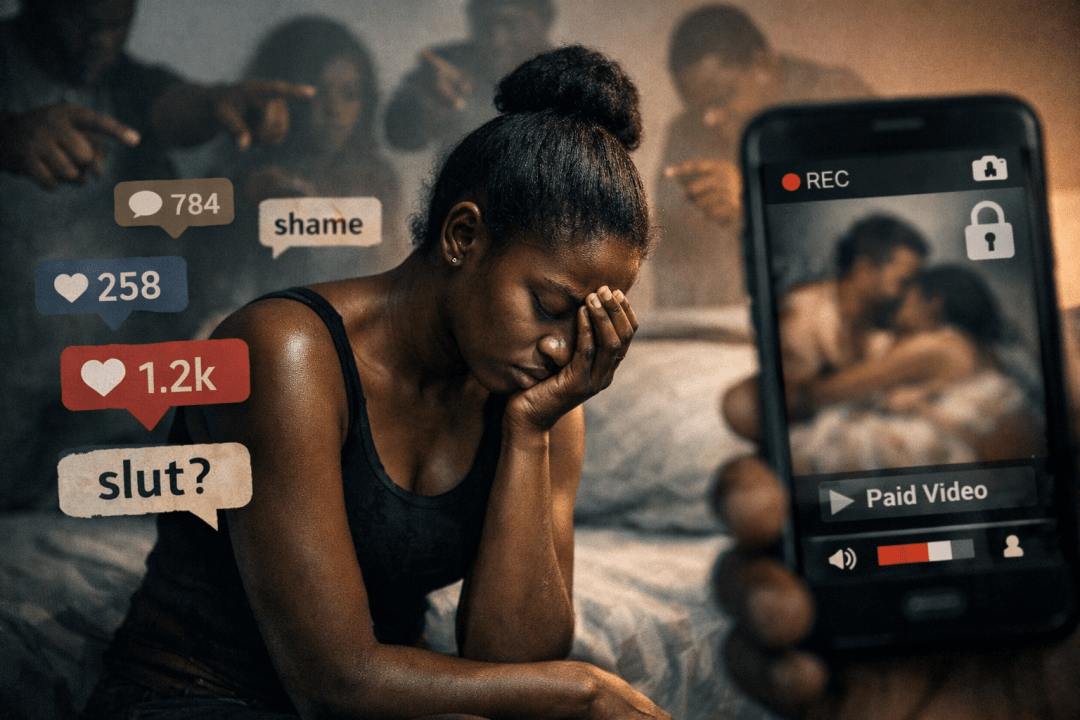
What our reactions to women’s sexuality reveal about power, dignity, and responsibility.
There has been a story circulating in the Ghanaian digital space this week.
A foreign man approached multiple Ghanaian women, took them to his rented apartment, and it later emerged that many of these encounters had been recorded and placed behind a paywall — without the women’s consent.
That is a violation.
But what has unsettled me most is not only the act itself.
It is the reaction that followed.
Because when the story broke, the loudest conversations were not about consent.
They were not about digital exploitation.
They were not about the ethics of recording and selling someone’s body without permission.
They were about the women.
Why did they go there?
Why did they make it “easy”?
How much were they paid?
Who else had access?
There was laughter.
There was name-calling.
There was celebration.
And in that moment, the violation became secondary to the policing of women’s bodies.
This is not a new pattern.
When a woman’s private sexual decision becomes public, her morality becomes a public debate.
When a man violates her consent, her character becomes the headline.
Some of the commentary did not sound like concern for women’s safety.
It sounded like ownership.
It sounded like competition.
It sounded like anger that someone else had access.
So I find myself asking questions that go beyond this one incident.
Why was the central outrage not the non-consensual recording?
At what point did consent stop being the primary issue?
When did exploitation become less important than judging women’s choices?
If this had happened to someone we loved — a sister, a friend, a daughter —
would our language have been the same?
Or would we have asked who violated her privacy?
There is also a digital reality we are still refusing to take seriously.
Recording someone without consent is not gossip.
Selling that recording is not entertainment.
It is a form of harm that does not disappear, because the internet does not forget.
Yet the social consequences are carried almost entirely by the women.
I am not writing this to defend anyone’s sexual decisions.
Adults make choices, and those choices come with their own risks and responsibilities.
But there is a difference between personal responsibility and public dehumanisation.
There is a difference between discussing safety and celebrating exploitation.
There is a difference between values and control.
What concerns me is not that people have opinions about sex.
What concerns me is that our moral energy seems to activate most strongly when there is a woman to shame.
We asked whether the women were careful.
We asked whether they were “cheap.”
Some asked whether the man could have been dangerous.
But very few asked why consent was ignored.
And that is the reflection I am left with:
When something harmful happens, the direction of our outrage reveals our values.
Do we centre dignity, or do we centre control?
Do we take consent seriously, or only when it is convenient?
Do we protect people, or do we perform morality at their expense?
Because the next time something like this happens — and in a digital world, it will —
we will again be faced with the same choice:
To ask who was harmed,
or to ask who we can shame.
And that choice will tell us who we are.
Discover more from Koya Nkrumah
Subscribe to get the latest posts sent to your email.

 Koya Nkrumah