
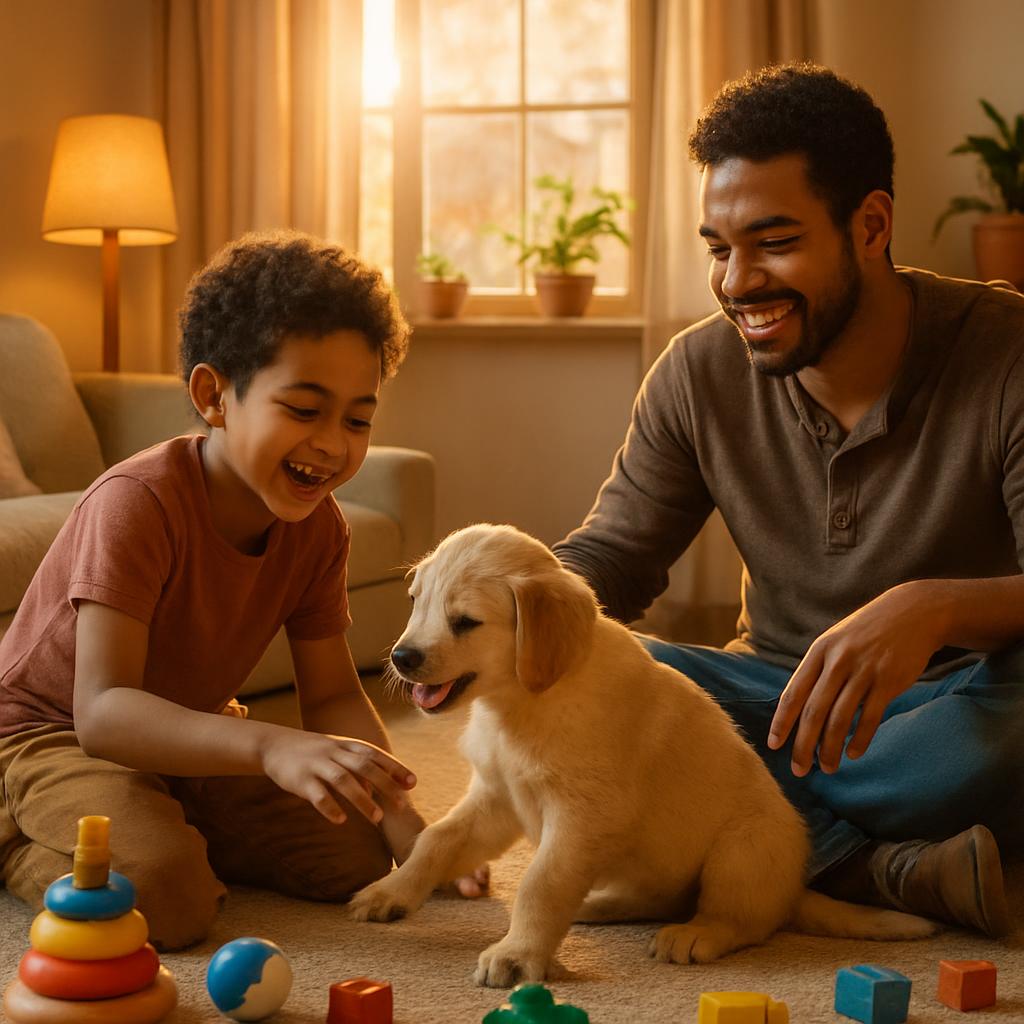
All year, David begged for one thing — a puppy.
Every dinner conversation, every birthday card, every whispered bedtime wish carried the same hope:
“Please, can I have a puppy for Christmas?”
On Christmas morning, it finally happened.
Wrapped in a red bow, nestled in a box with holes poked through, was a tiny golden retriever. David squealed with joy. He named her Sunny — her golden fur reminded him of sunshine, and she made his heart feel warm.
The first few days were magical.
David played with Sunny nonstop. He fed her treats, let her lick his face, and proudly declared, “She’s my best friend! I’ll take care of her forever!”
Then school started again.
Homework piled up. Video games called. Sunny still needed walks — but it was cold outside. She chewed shoes, had accidents in the house, and cried at night.
David began forgetting her water. He rushed her walks — or skipped them. The excitement faded. But Sunny’s needs didn’t.
Eventually, David’s older sister started doing the morning walks. His mum began feeding, cleaning up messes, booking vet appointments. David still said he loved Sunny, but at some point, that love became something he felt — not something he did.
Sunny still needed care. But it wasn’t David who gave it.
Ever heard the saying, “Men want children the way children want puppies”? This saying, though a generalisation, carries a sharp truth I’ve seen play out far too often.
Like little David, I feel many men dream of fatherhood in beautiful, curated snapshots: a baby giggling on their lap, a triumphant kick of a football in the park, a proud graduation day. These are the highlight reels, the moments that fill the photo albums. But parenting, much like puppy ownership, is so much more than these cherished moments. It’s the messy, constant, often exhausting, and largely invisible work that happens between them.
The joy of seeing your child thrive is undoubtedly shared, but all too often, the bulk of the daily responsibility isn’t. While many fathers are incredibly present and active – and we celebrate them wholeheartedly – far too often, the ceaseless labor of parenting still disproportionately falls on mothers. Mothers are the ones packing the lunches, navigating the parent-teacher meetings, staying up all night with sick kids, remembering every birthday, and carrying the vast majority of the emotional heavy lifting. Children, like puppies, don’t just need love. They need care. Daily. Consistent. Often thankless.
I know some traditionalists will argue that managing the home and raising children are roles “reserved” for women, allowing men to focus solely on providing and protecting. But let’s be honest, the world is no longer as “traditional” as it once was. Most households today depend on two incomes to simply survive. Expecting one adult to shoulder all domestic responsibilities and child-rearing duties on top of working full-time is a recipe for burnout – and frankly, it’s something many women are walking away from.
Current studies on divorce rates paint a telling picture: a significant majority of wives are initiating divorces. And what’s a common thread among divorce lawyers? Many women cite sheer exhaustion from carrying the entire domestic and childcare load as their primary reason. We’re seeing a critical shift in conversation, moving beyond just physically absent fathers to address the many fathers who are “at home but absent in so many ways” – giving rise to the poignant term, “married single mothers.”
When Father’s Day rolls around, there’s often a debate about why it isn’t celebrated with the same fervor as Mother’s Day. And while there are many layers to that difference, perhaps it boils down to this: certain traditional beliefs haven’t evolved with the times. Simply going to work and “bringing home the bacon” is no longer enough. The narrative around fatherhood is undeniably changing, and women, myself included, are no longer interested in men who see fatherhood as mere presence, rather than active, everyday engagement.
I once conversed with someone who pursued his dream of becoming a lawyer in his 40s, leaving his children on another continent. He often denied having kids; when he could no longer avoid the truth, he listed his daughter’s school, teacher’s name, and favorite activities, as if that summed up responsible parenting. When probed deeper about her fears, insecurities, and challenges, he had no answers. Now, I understand that sometimes parents must make sacrifices that take them away from their children’s lives. However, children perceive things differently than their parents do, which speaks to the muted way many view Father’s Day. Just like David’s puppy, children tend to trust the person who walk beside them, gives them baths, feeds them, and acknowledges their presence.
So, this Father’s Day, let’s celebrate the men who do the work, not just the ones who exist near it. The ones who pack the lunches and remember the allergy meds. Who know their child’s fears aren’t “just a phase.” Who understand that love isn’t a feeling—it’s action with sticky floors and sleepless nights. The ones who know which stuffed animal is the “guardian of nightmares,” who’ve mastered the art of braiding hair – this day is yours. Not because society demands it, but because your love demonsrates it. You prove that fatherhood isn’t about biology, but about showing up, even when it’s inconvenient, exhausting, or invisible
Because here’s the truth: Sunny won’t love David just because she’s her dog. She’ll love whoever chooses her, day after day, in a thousand invisible ways.
And to the fathers who’ve let the weight of parenting fall on others: this isn’t condemnation—it’s an invitation. Your children don’t need grand gestures or guilt-driven gifts. They need you: present, imperfect, and trying. Sunny still wags her tail when David remembers to play with her. Imagine what your kids could bloom into if you watered them with the same consistency.
Thank you for taking the time to connect, share, like, and comment. Let’s continue to inspire the change we need by sharing our experiences.
Discover more from Koya Nkrumah
Subscribe to get the latest posts sent to your email.

 Koya Nkrumah
This piece was incredibly moving and much needed. The analogy of David and the puppy offers a sharp and honest reflection of how many people, especially men, romanticize fatherhood, desiring the joyful moments without considering the responsibility that accompanies them. And that’s where the truth hits hardest: love isn’t just a feeling; it’s a consistent, often invisible action.
It immediately reminded me of Ifunanya’s viral TikTok testimony, the one where she shared how her father, after retiring in New York, returned to Nigeria and was held hostage by his siblings for months. What broke my heart was when she said, “I didn’t feel the difference because he’d never truly been present.” That line stopped me cold. Imagine your father being absent, and you barely feel the shift because his absence had always been emotional, even when he was physically there.
Her story, like yours, drives home the truth that parenting and fatherhood involve more than mere existence. It’s about showing up in ways that matter: emotionally, mentally, and physically. It’s about choosing your children every day, not just when it’s convenient or Instagram-worthy.
Thank you for writing this. These aren’t just reflections; they’re reality checks. The fact that more women are sharing the truth about being “married or single mothers” shows that the world is shifting. We’re no longer clapping for the bare minimum. Real fatherhood is about presence, partnership, and purpose. Period.
LikeLiked by 1 person
Thank you for thinking about the fathers. God bless you!
LikeLike