
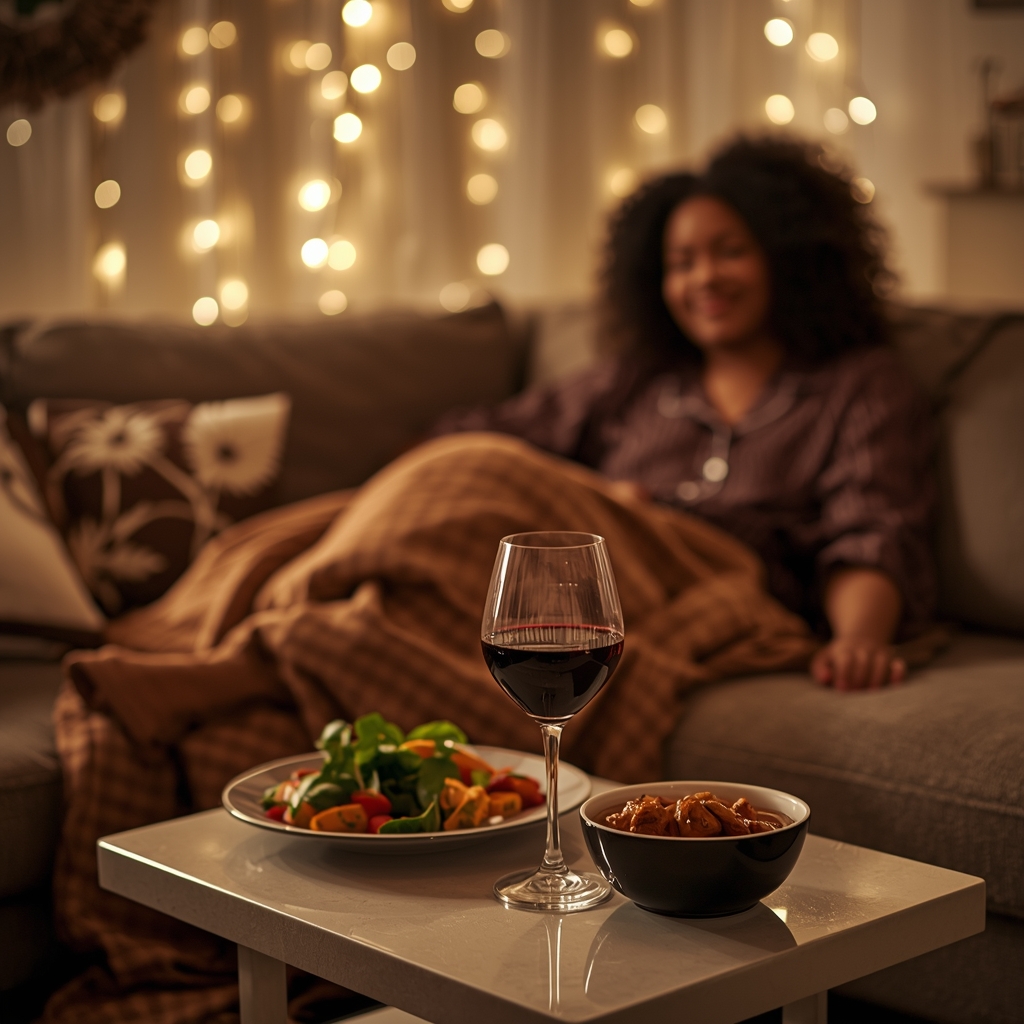
For the first time, I didn’t feel like I was on the outside looking in.
That’s how Christmas had felt for most of my life — never quite mine. I was always present for someone else, or present simply because it was deemed unacceptable to be alone on Christmas. But this year, I didn’t perform Christmas — and it changed everything.
Simply Being
I chose to simply be.
I decided to recreate moments I had missed or been denied in past Christmases, not to prove anything, but because this one was for me. Everything I did was intentional. I chose what to eat and how to eat it: a simple Ghanaian chicken stew with rice, prepared the day before and paired with salad. A glass of wine, not to numb or escape, but to complement the meal.
These small, deliberate choices brought me a sense of peace and contentment I had never known during previous festive seasons.
When Christmas Feels Different
Online, many people said Christmas didn’t feel the same this year — and I understood what they meant. With the cost-of-living crisis and the general uncertainty around us, it makes sense that the season feels different.
Mine was different too, but not in the way many described.
It was slow. Intentional. I spent most of the day in my pyjamas, under a duvet on my sofa — and I was content.
I also noticed many migrants, particularly Ghanaians, mourning the absence of the kind of Christmas they knew: outside activities, concerts, church gatherings, constant movement. For many living in the diaspora, it came as a shock that once the shops closed on Christmas Eve, the world became still — as people retreated indoors to spend the day with family and loved ones.
Tradition, Consumerism, and Memory
Christmas has always been contested. Some argue it has become too commercialised; others reject it altogether, citing pagan roots aligned with the winter solstice. While I don’t align strongly with either position, I do recognise how deeply consumerism has reshaped expectations — replacing the simplicity of gift-giving with pressure, performance, and excess.
Growing up in Ghana, gifts were practical. Often, they were food — a way of ensuring no one went without and that community was sustained. Parents bought clothes for children to wear to church and celebrations. It was communal, inclusive, and grounded.
While things are evolving back home, it still cannot be compared to the level of consumerism embedded in Western Christmas culture.
The Christmases That Weren’t Mine
My own childhood Christmases were complicated. Not because of lack, but because my parents were not around and I lived with my aunt and her family. Anyone entering that home could sense I didn’t belong — and I felt it.
Christmas meant staying on the fringes, navigating my aunt’s unpredictable rage, constantly alert. I had good clothes and good food, but no agency, no safety, no voice.
Years later, I learned what trauma had already taught my body. As Dr. Bessel van der Kolk says, the body keeps the score. Christmas never felt like mine — it belonged to others, and I merely attended.
After being reunited with my mother and living with her briefly, she died two days before Christmas. Whatever fragile joy I had left vanished. I stopped celebrating — grief and loss made it feel pointless. More losses followed. More wounds. And so Christmas became something I endured rather than inhabited.
Reclaiming Joy, Gently
Life, however, has a way of surprising us.
My nephew and niece slowly drew me back in — their excitement, their innocence. Watching Disney classics together, something I associate deeply with my mother. Playing board games, one of the few good memories from my aunt’s house.
Through them, I began reclaiming fragments of Christmas, though it still never fully felt like mine.
Until this year.
This year, I stopped trying to *let go* of the past and chose instead to nurture the little wounded girl inside me. Reclaiming joy wasn’t about erasing pain — it was about restoring what had been denied.
Therapy. Intentional living. Solo travel that healed my soul. All of it led me here.
Christmas on My Terms
So we created Christmas on our terms.
A menu that honoured what we weren’t allowed to enjoy: slow-cooked Ghanaian chicken stew, party chips, donuts, cakes, butter cookies. This was my way of choosing joy.
I shopped intentionally. I chose practical gifts for people I love. I shared a meal with a dear friend who has been a pillar this year. I visited a new mother, shared tea, and cuddled her angelic new addition.
I spent time with friends I met years ago in the same workplace — the same people, evolved, supporting one another through changing seasons of life. I decorated my Christmas tree with one of my favourite people, witnessing her grow from a little girl craving sleepovers into a young woman becoming herself.
Letting Joy Be Quiet
By the time Christmas Day arrived, joy was already present — within me and around me.
There was no rush. No performance. I ate simply. I stayed in my pyjamas. I rested. I opened presents slowly and cried over handwritten words that truly landed. I napped after meals and struggled to sleep later — and I smiled through it all.
Some asked if I was lonely.
But I had been lonely for years in rooms full of people.
This time, I was content. Fully present in my own company. I had options to be elsewhere — and I chose this. My way.
Joy didn’t come in a crowded room or a table overflowing with food. It came in choosing myself. In celebrating on my own terms.
Maybe joy doesn’t have to be loud or performative. Maybe it doesn’t require overspending to fill wounds only reflection and healing can touch.
Maybe joy is allowing yourself — and others — to be present in their own lives, without watching from the outside.
And if your Christmas felt different this year — because of finances, distance, grief, or change — remember this:
You matter. And you deserve joy that honours who you are now.
I’d love to hear how this season met you. Share your experience — let’s make space for the kind of change we all need.
Discover more from Koya Nkrumah
Subscribe to get the latest posts sent to your email.

 Koya Nkrumah
Season’s greetings, Koya.
LikeLiked by 1 person
And to you, Anita. X
LikeLike
Great
LikeLike